Culture · 3 min read
Five tattoo artists who changed the craft, and their stories
A Kalinga elder, a Navy sailor in Honolulu, a Yokohama master, a San Francisco showman and the art student who became their bridge.
M.D Cost, Copywriter, DyeDem ·
Every style you can book today was shaped by people who refused to do things the easy way. These five artists came from very different places, but each changed how the world sees tattooing.
Apo Whang-Od: the keeper of batok
In Buscalan, a mountain village in Kalinga, Maria Oggay, known to everyone as Apo Whang-Od, learned the art of batok from her father as a teenager. Batok is tapped into the skin by hand, using a thorn fixed to a stick and a pigment of soot and water. For generations, these markings honoured warriors and adorned women, and each design carries meaning.
Whang-Od became known as the last mambabatok of her generation. As travellers began making the long trip to Buscalan, she trained her grandniece Grace Palicas and other young relatives so the practice would continue. In 2023, at 106, she appeared on the cover of Vogue Philippines, the oldest person ever to front a Vogue cover.
Norman "Sailor Jerry" Collins: the father of American traditional
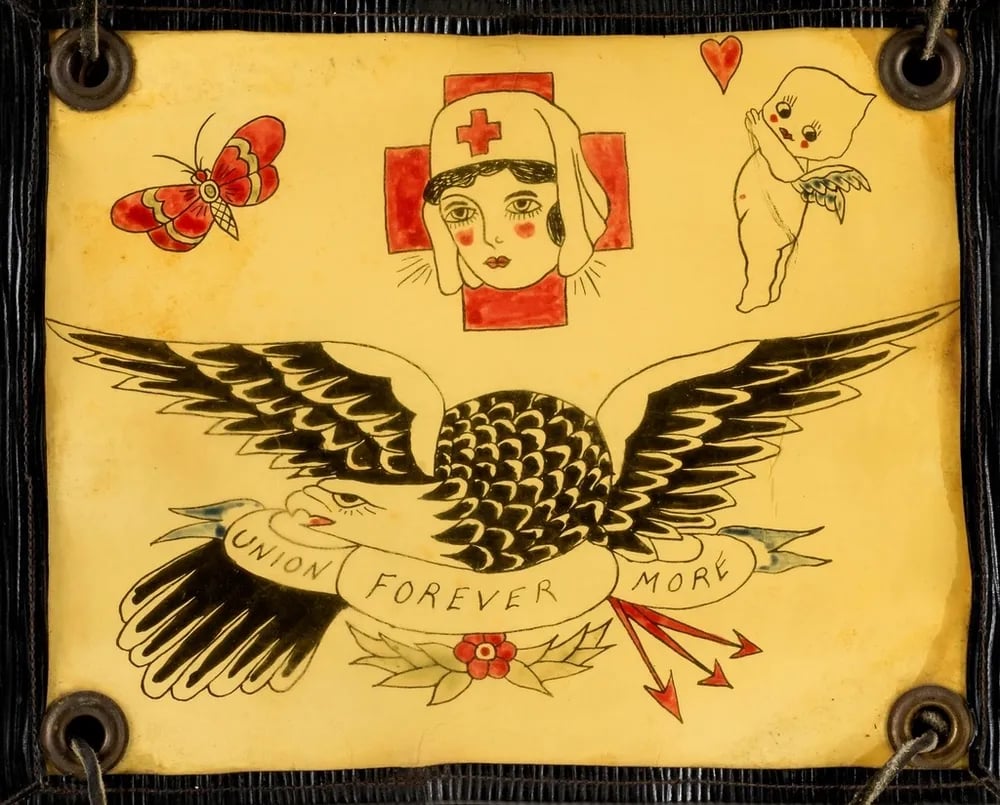
Born in 1911, Norman Collins hitchhiked and rode freight trains across the United States as a young man and learned to tattoo along the way. After serving in the US Navy, he settled in Honolulu, where he tattooed thousands of sailors and soldiers on shore leave during and after the Second World War.
His bold lines, solid colour and pin-ups, swallows, anchors and daggers defined what we now call American traditional. He also traded letters and designs with Japanese masters, mixed his own pigments and was among the first in his trade to take sterilisation seriously. He died in 1973, and his flash is still tattooed every day.
Horiyoshi III: master of tebori
Yoshihito Nakano was born in 1946 in Shizuoka. As a boy, he saw a man with a full Japanese bodysuit at a public bath and never forgot it. He became an apprentice to Yoshitsugu Muramatsu, the first Horiyoshi of Yokohama, who gave him the title Horiyoshi III in 1971.
Working largely by hand in the tebori tradition, he became one of the most respected Japanese tattooers alive, known for dragons, koi, deities and full bodysuits that move with the body. He also founded a tattoo museum in Yokohama to preserve the history of his craft.
Lyle Tuttle: tattooing goes mainstream
Lyle Tuttle bought his first tattoo at 14 and opened his own studio in San Francisco in 1954. In 1970, he tattooed a small bracelet design on Janis Joplin's wrist. When a rock star showed off her ink, a generation took notice, and that same year Tuttle appeared on the cover of Rolling Stone.
He went on to tattoo musicians and actors, collect tattoo history and campaign for the craft's respectability. When he died in 2019 at 87, he was often called the granddaddy of modern American tattooing.
Don Ed Hardy: the bridge between East and West
Don Ed Hardy grew up in Southern California, fascinated by tattoos from childhood. He studied printmaking at the San Francisco Art Institute and turned down a graduate place at Yale to tattoo full time. Encouraged by Sailor Jerry, with whom he traded letters, he travelled to Japan in 1973 to study with the master Horihide, one of the first Westerners to do so.
Back in San Francisco, he opened Tattoo City and championed custom, large-scale work designed with each client instead of picked off the wall. He also published books and organised events that taught a generation to see tattooing as fine art. His name later became a global clothing brand, but his real legacy is in how artists think about their work.
Tattooing has always passed from hand to hand: father to daughter, master to apprentice, sailor to sailor. Every artist today is part of that line.